

Botanica Gaia
Extrait sélectif CO2 de gingembre rouge | Zingiber officinale var. rubrum
Extrait sélectif CO2 de gingembre rouge | Zingiber officinale var. rubrum
Extrait sélectif au CO₂ de gingembre rouge (Zingiber officinale var. rubrum), un extrait botanique riche, chaud et épicé pour la parfumerie naturelle, les soins de la peau, les soins capillaires et les formulations.
Impossible de charger la disponibilité du service de retrait
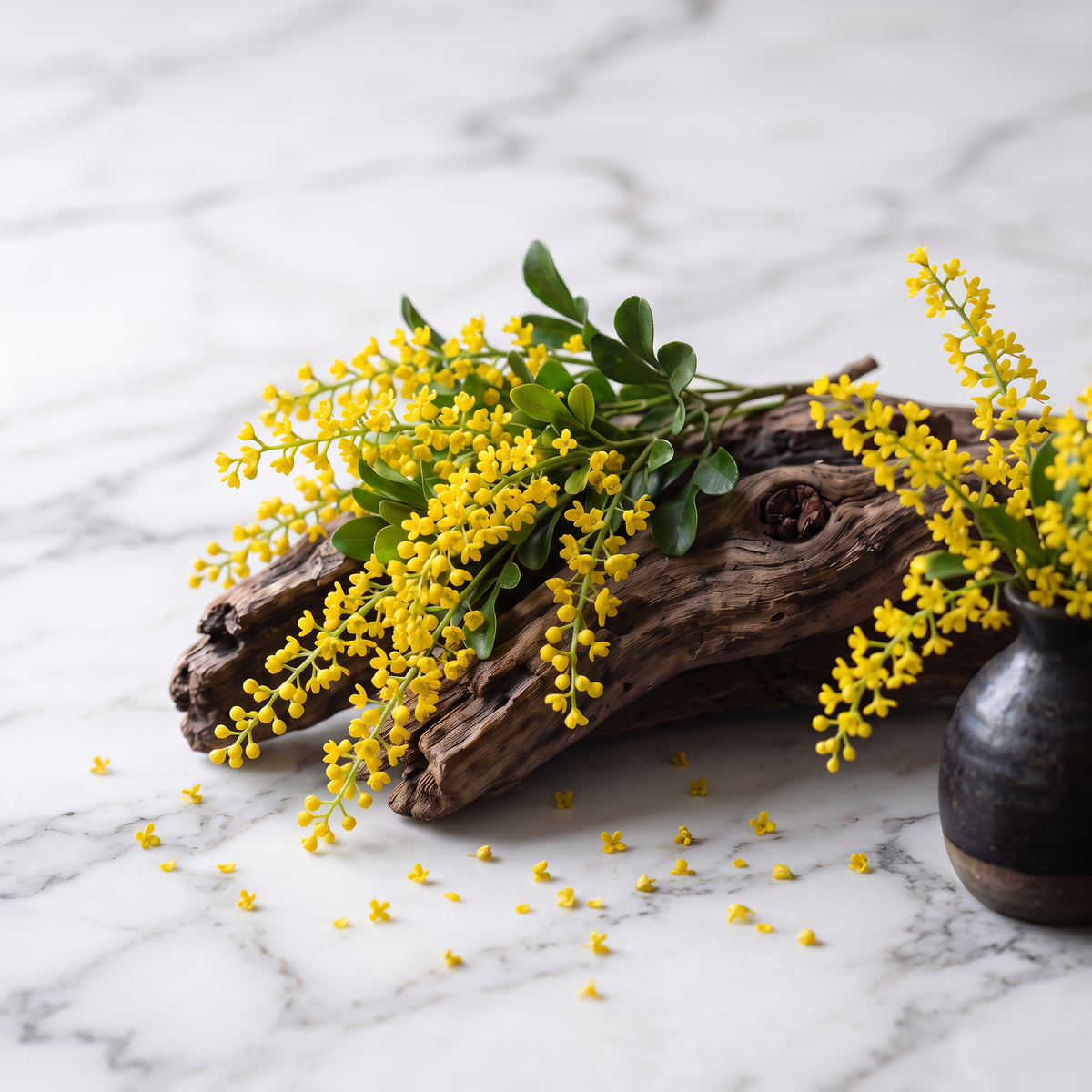
Discover the delicate elegance of Aglaia Wax, a rare botanical aromatic wax derived from the fragrant flowers of Aglaia odorata, commonly known as Chinese Rice Flower or Chinese Perfume Plant.
Native to tropical and subtropical regions of Asia, Aglaia odorata is admired for its clusters of tiny golden-yellow blossoms and their distinctive sweet, floral fragrance.
Aglaia Wax offers natural perfumers and botanical formulators an intriguing ingredient for exploring the aromatic and textural characteristics of this uncommon flower.
Floral waxes are generally composed of naturally occurring waxy and lipid-soluble constituents recovered during botanical extraction and processing. Depending on the production method, they may retain varying amounts of aromatic compounds responsible for the plant's distinctive fragrance.
Aglaia Wax is particularly interesting for natural solid perfumes, botanical fragrance balms, artisan perfumery, and luxurious anhydrous cosmetic formulations.
Its botanical character complements floral absolutes, essential oils, CO₂ extracts, natural resins, and precious aromatic materials.
For perfumers seeking uncommon natural ingredients, Aglaia Wax provides an opportunity to incorporate a rare Asian botanical into sophisticated fragrance compositions.
Botanical Wax Recovery
Floral waxes can be recovered as fractions during the extraction and purification of aromatic botanical materials.
In some production processes, wax-rich components are separated from an aromatic extract through cooling, precipitation, filtration, or other purification techniques.
These fractions may contain naturally occurring lipids, wax esters, and residual aromatic compounds.
Caractéristiques de l’extrait CO2 de gingembre rouge.
- Nom botanique :Zingiber officinale var. rubrum.
- Famille :Zingiberaceae.
- Noms communs :Gingembre rouge, Zinziber rouge.
- INCI :Zingiber Officinale var. rubrum (Red Ginger) Root Extract.
- Méthode d’extraction :CO2 supercritique.
- Partie utilisée :Rhizomes.
- Note :Note de cœur.
- Odeur :Riche, forte, profonde, chaude et épicée.
- Aspect :Jaune clair.
- Pays d’origine :Indonésie.
- Principaux composants indiqués :Alpha-zingibérène et zingibérène.
Aroma Profile:
Aromatic Family: Floral • Fruity • Green • Tea-Like
- Top Notes: Delicate fruity freshness with soft green and faint citrus nuances.
- Heart Notes: Sweet floral notes, fresh blossoms, and subtle green tea impressions.
- Base Notes: Gentle woody, herbal, and soft botanical undertones.
- Aroma Character: Delicate, elegant, exotic, naturally sweet, and subtly complex.
- Perfumery Classification: Floral modifier; primarily heart-note applications, depending on the individual extract.
- Aroma Intensity: Batch-dependent.
The precise aromatic character should be evaluated through organoleptic testing of the finished extract.
Formulation Notes:
Composition & Information on Ingredients:
Aglaia Wax may require gentle heating to achieve a homogeneous blend with suitable oils or other waxes.
Its melting behavior, crystallization properties, and compatibility should be evaluated before incorporating it into finished products.
Avoid unnecessary prolonged heating, as this may affect any retained volatile aromatic constituents.
Suggested Usage Level
No universally established usage concentration is available for Aglaia Wax.
The appropriate concentration depends on:
- Wax composition.
- Melting characteristics.
- Desired product consistency.
- Fragrance intensity.
- Compatibility with other ingredients.
- Finished-product safety requirements.
For solid perfume development, formulate experimental batches and evaluate hardness, stability, aroma release, and skin compatibility.
Important Aroma & Formulation Note
Aglaia Wax is not equivalent to Aglaia Absolute or Aglaia CO₂ Total Extract.
While absolutes and aromatic CO₂ extracts are generally selected for their concentrated fragrance characteristics, floral waxes may contain a greater proportion of heavier, less-volatile constituents.
Consequently, Aglaia Wax may provide:
- A softer botanical aroma.
- Additional waxy texture.
- Different solubility characteristics.
- Different melting and crystallization behavior.
- A distinct formulation profile.
These characteristics depend on the actual composition of the finished wax.
Botanical Wax Fraction:
Aglaia Wax may contain naturally occurring lipid-soluble constituents associated with botanical waxes, including:
- Long-chain fatty acids.
- Long-chain fatty alcohols.
- Fatty acid esters.
- Hydrocarbons.
- Higher-molecular-weight lipophilic constituents.
- Residual volatile aromatic compounds.
Floral Combinations
- Jasmine Sambac Absolute.
- Jasmine Grandiflorum Absolute.
- Osmanthus Absolute.
- Magnolia Absolute.
- Neroli Essential Oil.
- Rose Absolute.
- Orange Blossom Absolute.
- Ylang Ylang Extra.
- Gardenia Absolute.
Fruity & Citrus Combinations
- Mandarin Essential Oil.
- Bergamot Essential Oil.
- Sweet Orange Essential Oil.
- Yuzu Essential Oil.
- Pink Grapefruit Essential Oil.
Woody Combinations
- Sandalwood Essentil Oil.
- Hinoki Essential Oil.
- Cedarwood Essential Oil.
- Vetiver Essential Oil.
Resinous Combinations
- Frankincense Essential Oil.
- Elemi Essential Oil.
- Benzoin Resinoid.
- Labdanum Absolute.
Botanical & Gourmand Combinations
- Ambrette Seed CO₂ Extract.
- Vanilla CO₂ Extract.
- Tonka Bean Absolute.
- Cardamom CO₂ Extract.
- Green Tea Extract.
Best For
- Luxury natural perfumery.
- Rare floral fragrance compositions.
- Botanical solid perfumes.
- Floral and fruity accords.
- Green tea-inspired fragrances.
- Premium botanical ingredients.
- Artisan perfume development.
- Niche botanical fragrance collections.
- Advanced cosmetic formulation research.
Traditional & Cultural Significance
Aglaia odorata has a long history of appreciation in Asian horticulture and traditional aromatic practices.
Its tiny, fragrant blossoms have been valued for their pleasing scent and association with botanical beauty and refinement.
In contemporary natural perfumery, Aglaia offers an unusual floral character that can complement both classical and modern fragrance compositions.
Important Aroma Note
Although Aglaia CO₂ Total Extract and Aglaia Absolute originate from the same botanical species, they are not necessarily interchangeable.
Differences in extraction technology may influence the concentration of volatile aromatic compounds, heavier botanical constituents, texture, and overall fragrance performance.
A direct comparison between the two materials should always be performed using representative samples.
Utilisations en soins de la peau
L'extrait CO₂ sélectif de gingembre rouge peut être incorporé dans diverses formulations botaniques pour les soins de la peau, notamment :
- Huiles pour le visage.
- Sérums.
- Huiles pour le corps.
- Baumes.
- Crèmes.
- Lotions.
- Beurres corporels.
- Produits botaniques pour les soins de la peau
Sa nature concentrée le rend adapté aux formulations nécessitant une petite quantité d'un extrait botanique distinctif.
Utilisations en soins capillaires
Il peut également être incorporé dans :
- Huiles capillaires.
- Sérums capillaires.
- Masques capillaires.
- Soins revitalisants.
- Formulations pour le soin du cuir chevelu.
- Produits botaniques pour les soins capillaires.
Parfumerie naturelle
L'extrait CO₂ sélectif de gingembre rouge est particulièrement intéressant pour la parfumerie naturelle. Son riche caractère épicé peut apporter chaleur, complexité et profondeur aux compositions de parfum.
Il peut être associé à :
- La bergamote.
- La mandarine.
- L'orange douce.
- La cardamome.
- Le poivre noir.
- Le bois de cèdre.
- Le bois de santal.
- Le patchouli.
- L'encens.
- D'autres extraits d'épices et de plantes.
Sécurité
Même en petite quantité, ce produit est très puissant et doit être dilué avant utilisation.
- Pour usage externe uniquement.
- Ne pas ingérer.
- Ne pas appliquer pur.
- Ne pas utiliser pendant la grossesse ou l’allaitement.
- Faites preuve d’une prudence extrême avec les enfants.
- Si vous êtes épileptique, souffrez de lésions hépatiques ou de cancer, présentez une autre affection médicale ou prenez des médicaments, utilisez ce produit uniquement sous la supervision d’un praticien qualifié en aromathérapie.
Les informations fournies décrivent des usages traditionnels et cosmétiques et ne sont pas destinées à diagnostiquer, traiter, guérir ou prévenir une maladie.
Professional purchasing
Need a larger quantity, documentation or sourcing support?
Partager
The information presented here is for educating our customers about the traditional uses of essential oils and is not intended to diagnose, treat, cure, or prevent any disease. You are responsible for understanding the safe application of these products.